

What Your Dog Actually Sees
What this means in practice
What Your Dog Actually Sees
Choosing Colors at Slobber & Stitch
Dogs don't see the world in black and white
That's the old myth, and it's wrong. Dogs see color — just a narrower range of it than we do.
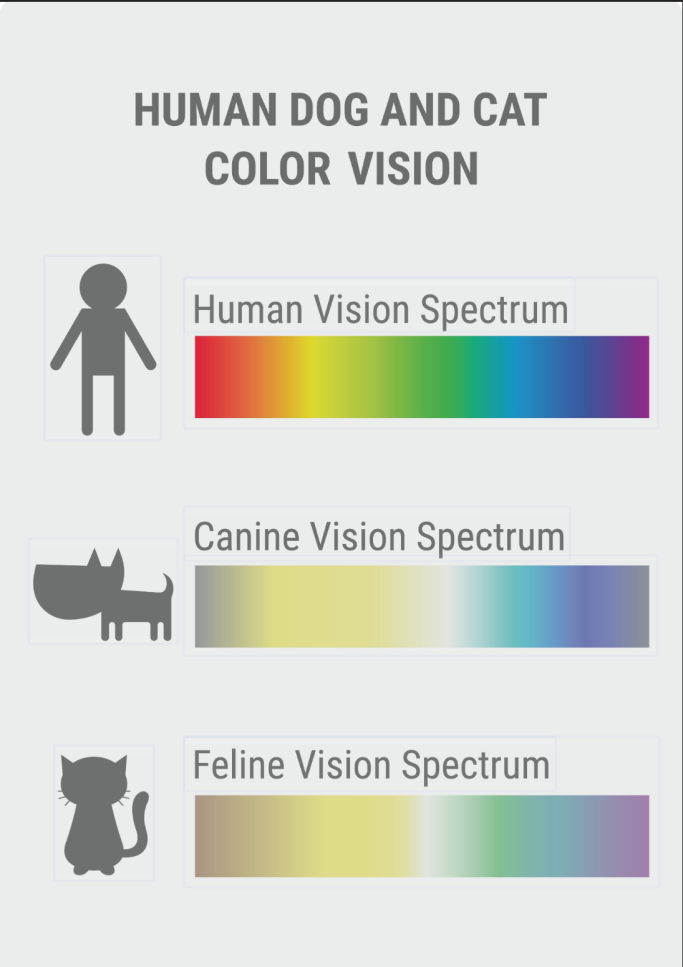
Humans are trichromatic: three types of cone cell in the retina, giving us the full red-through-violet spectrum. Dogs are dichromatic: two cone types instead of three. Their vision is functionally similar to a person with red-green colorblindness.
Two peaks define what a dog can distinguish, and published vision research puts them at roughly:
- 429 nanometers — the blue-violet range
- 555 nanometers — the yellow-green range
Everything a dog sees in color falls somewhere between and around those two anchors.
What this means in practice
Blues and yellows read clearly. These sit closest to your dog's two cone peaks. A royal blue tug against green grass is about as visible as a dog's color vision gets.
Reds and greens don't. They collapse toward yellow-brown and grey. A bright red toy on a green lawn — vivid to you — is closer to brown-on-grey for your dog.
Brightness works differently than color. A dog's retina is rod-dominated, which means it registers luminance — sheer brightness — as a separate channel from hue. A very bright strand next to a very dark one reads clearly to a dog even when neither color itself carries much information.
How we built our palette around this
[Place the color palette image here]
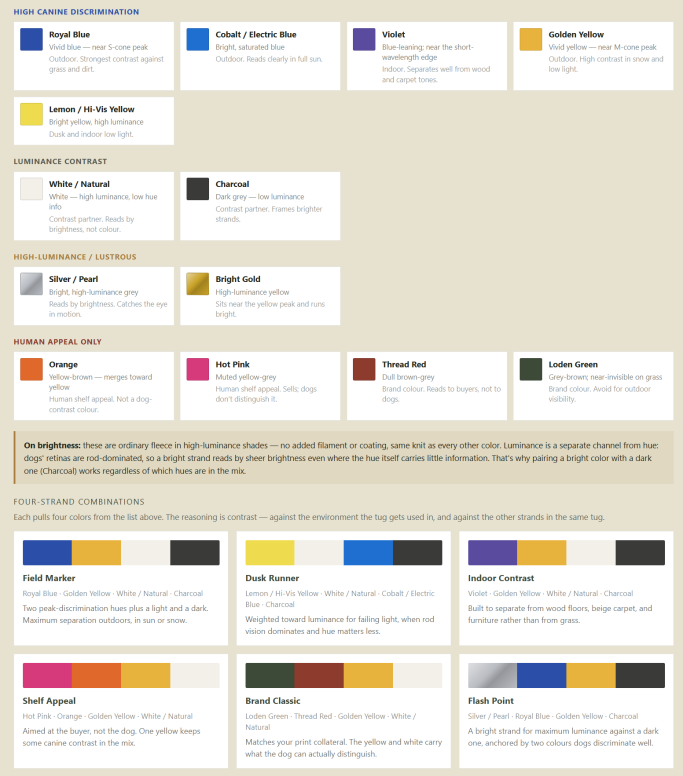
Our eight-color palette isn't chosen at random. It's sorted by what the dog on the other end of the tug can actually distinguish.
High canine discrimination
Royal Blue · Cobalt / Electric Blue · Violet · Golden Yellow · Lemon / Hi-Vis Yellow
These sit near your dog's two cone peaks. Royal Blue gives the strongest contrast against grass and dirt. Golden Yellow reads clearly in snow and low light. Violet separates well from indoor wood and carpet tones.
Luminance contrast
White / Natural · Charcoal
Read by brightness rather than hue. These are the partners that make everything else pop — a bright strand framed by a dark one works regardless of which colors are in the mix.
High-luminance / lustrous
Silver / Pearl · Bright Gold
Ordinary fleece in especially bright shades — no added filament or coating, the same knit as every other color. They catch the eye in motion through brightness alone.
Human appeal
Orange · Hot Pink · Thread Red · Loden Green
Worth being straight about these: your dog can't really distinguish them. Orange merges toward yellow, hot pink reads as a muted grey, and Loden Green is close to invisible against grass. They're here because people like them — and there's nothing wrong with that. It's your toy too.
Suggested combinations
Field Marker — Royal Blue · Golden Yellow · White · Charcoal Two peak-discrimination hues plus a light and a dark. Maximum separation outdoors, in sun or snow.
Dusk Runner — Hi-Vis Yellow · White · Cobalt · Charcoal Weighted toward luminance for failing light, when rod vision dominates and hue matters less.
Indoor Contrast — Violet · Golden Yellow · White · Charcoal Built to separate from wood floors, beige carpet, and furniture rather than from grass.
Shelf Appeal — Hot Pink · Orange · Golden Yellow · White Aimed at you, not the dog. One yellow keeps some canine contrast in the mix.
Brand Classic — Loden Green · Thread Red · Golden Yellow · White Our own colors. The yellow and white carry what the dog can actually distinguish.
Flash Point — Silver / Pearl · Royal Blue · Golden Yellow · Charcoal A bright strand for maximum luminance against a dark one, anchored by two colors dogs discriminate well.
A note on what this is and isn't
Everything on this page is published research about canine vision in general — how dogs' eyes work, which wavelengths they discriminate. It's well established and easy to look up.
What it isn't is a claim about our tugs specifically. We haven't tested whether a dog finds a blue Vector-S faster than a red one, or plays with it longer, or anything else. We used the vision research to choose a palette because it seemed like the sensible thing to do — not because we've measured a difference in how dogs respond to our products.
Pick whatever colors you like. If you want the ones your dog is most likely to distinguish, now you know which those are.
Sources
Behavioral discrimination studies and retinal research on domestic dogs establishing dichromatic color vision with cone spectral peaks near 429 nm and 555 nm.